Wildfire Smoke Protection
Revised June 2025
Purpose
This section is intended to provide an overview of safe practices and District safety expectations surrounding exposure to wildfire smoke and associated hazards.
Wildfire smoke is hazardous and exposure to high levels of smoke particulates can cause detrimental health effects.
Applicability
Protections are required for employees who don’t work in buildings or are not primarily working in enclosed vehicles.
Monitoring Air Quality
The District uses the EPA website AirNow/ www.AirNow.gov or the Air Quality WA mobile device app to monitor air quality (AQI PM2.5) in relation to wildfire smoke.
When wildfire smoke conditions are present, Safety and managers will monitor AQI regularly for at least two consecutive measurements at these action levels:
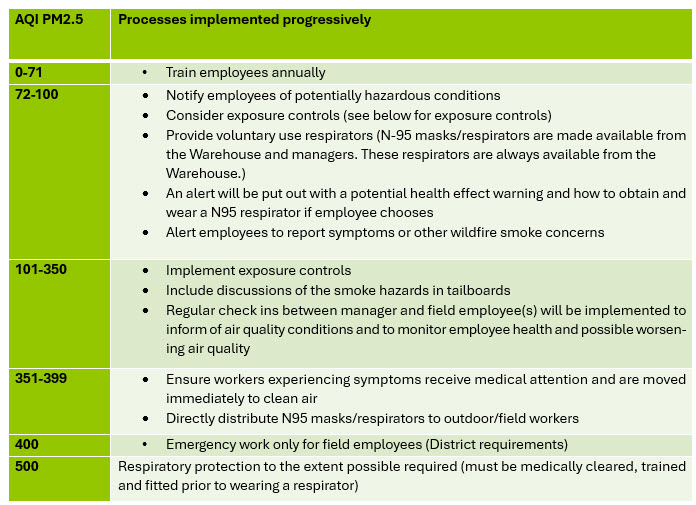
Exposure Controls
At the indicated AQI levels, field crews and outside workers are contacted, and arrangements will be made to:
AQI 101 or higher
- Work in enclosed structures or vehicles where the air is filtered; or
- Relocate workers to an area with a lower AQI for PM2.5; or
- Reduce work time in areas with unfiltered air; or
- Increase rest time and frequency in a rest area with filtered air; or
- Reduce the physical intensity of the work to help lower the breathing and heart rates.
AQI 301 or higher
- Ensure workers experiencing symptoms receive medical attention and are moved immediately to clean air.
- Directly distribute N95 masks/respirators to outdoor/field workers.
AQI 400 or higher
- Emergency work only
AQI greater than 500
- Respirator use required for employees participating in the Respiratory Protection Program (FIT Test).
- Employees not in the Respiratory Protection Program are expected to use protection up to N95.
- These controls do not apply if employee is exposed for 15 minutes or less in a 24-hour period.
Emergency response to protect, restore, or maintain safe and reliable operation of critical infrastructure may be required without exposure controls ( Exposure Controls WAC 296-820-835 (4)).
Report Symptoms of Exposure
Employees should contact their manager if they are experiencing health effects from smoke exposure or have questions/concerns.
Any symptoms that may potentially be related to wildfire smoke exposure including, but not limited to:
- Respiratory
- Cough
- Difficulty breathing
- Wheezing
- Shortness of breath, particularly when accompanied by greater use of accessory muscles.
- Asthma attack
- Runny nose
- Sore throat
- Sinus pain or pressure
- Phlegm
- Cardiovascular
- Chest pain or discomfort
- Fast or irregular heartbeat
- Feeling weak, light-headed, faint, or dizzy
- Pain or discomfort in the jaw, neck, or back
- Stroke Symptoms
- Sudden numbness or weakness in the face, arm, or leg, especially on one side of the body.
- Sudden confusion, trouble speaking, or difficulty understanding speech.
- Sudden trouble seeing in one or both eyes.
- Sudden trouble walking, dizziness, loss of balance, or lack of coordination.
- Sudden severe headache with no known cause.
- Headache; scratchy or irritated eyes; fatigue or tiredness.
Respiratory Protection
Voluntary use of a respirator for protection
N95 respirators are available from the Warehouse for voluntary use and may be requested at any time. When wildfire smoke conditions are hazardous, N95 masks/respirators will also be made available at the departments of outdoor workers.
For additional information, see Respiratory Protection section in the Accident Prevention Manual.
Training/Resources
Learning Central offers multiple trainings on Wildfire Smoke safety and protection and these trainings can be assigned to employee Learning Plans.
Additional sources of AQI data
- District:
- PowerBI Wildfire Watch Dashboard
- Washington Department of Ecology website
- U.S. EPA Fire and Smoke Map
- U.S. EPA AirNow mobile app – installed on District mobile devices
- U.S. Forest Service AirFire website
- Links:
- EPA air quality index site: AirNow: www.AirNow.gov
- Air Quality WA app for the iPhone/iPad
- Northwest Interagency Coordination Center provides an interactive map of wildfires in the Northwest: Interactive Map
- Washington State Dept of Health: Washington State Department of Health Air Quality
- Wildfire smoke WAC 296-820
- Airborne Contaminates WAC 296-841
- Respirators WAC 296-842
- Hazard Communication WAC 296-820-820